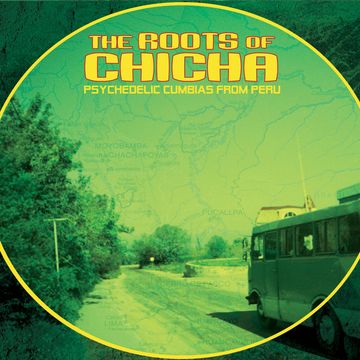
Psychedelic Amazonian cumbia did not come out of a Lima studio or a marketing office. It was born in towns like Pucallpa and Moyobamba, among oil workers, provincial musicians and cassettes passed from hand to hand, loaded with surf rock, spaghetti western soundtracks, Colombian cumbia and Brazilian carimbó. That informal crossover, later recorded by Infopesa, defined one of the most singular genres in Latin America.
Pucallpa and the 1970s oil boom
In the 1970s, oil transformed Pucallpa. Workers, engineers, traders and sound systems arrived; bars, brothels, local radio stations and a round-the-clock party economy grew with them. The town became a meeting point between the jungle, the coast and the wider world. Wherever there is cash in circulation and a mobile population, music speeds up.
Local bands had no access to top-tier studios, but they did have borrowed amplifiers, second-hand imported guitars and an audience willing to pay to dance. In that environment, soaking up influences was both a necessity and an advantage: whoever worked in a new riff won the following night.
Cassettes: the informal school of fuzz
Before the records reached Lima’s shops, cassettes did the heavy lifting. Workers and drivers carried recordings of psychedelic rock, surf and Italian western film music. Those sounds — reverb-drenched guitars, simple melodies, distant atmospheres — blended with the cumbia coming in from Colombia and with Brazilian rhythms travelling up the Amazon.
The result was neither a cover nor a parody: it was a third thing. Musicians took rock’s electric attitude and anchored it in cumbia drums and in scales that evoked their region. Fuzz stopped being decoration and became the lead voice, as Los Mirlos in Moyobamba and Juaneco y Su Combo in Pucallpa would show, with different approaches but shared raw material.
Shipibo tradition and electric modernity
In Pucallpa, the Shipibo-Conibo presence was not stage folklore but everyday neighbourliness. Juaneco y Su Combo wove that culture into their lyrics, their clothing and songs linked to ayahuasca with a naturalness few bands achieved. Electric modernity did not erase the tradition: it amplified it, sometimes controversially, always with symbolic force.
In Moyobamba, Los Mirlos built an imaginary centred more on wildlife, the river and the soundscape. Geography changes the story, but the technique — pedals, distortion, long solos — travels between Amazonian towns without necessarily passing through the capital.
Infopesa and the way out of the jungle
Industria Fonográfica Peruana S.A., founded by Alberto Maraví in Lima in 1971, was the channel that carried those sounds beyond the local circuit. Infopesa did not invent Amazonian cumbia, but it made it reproducible and distributable on a national scale. Its 45s and LPs reached markets where listeners had no idea where Moyobamba was, yet understood the beat.
The label recorded Los Mirlos, Juaneco y Su Combo and dozens of regional bands that complete the sound map of the Peruvian Amazon. Without that infrastructure, the cassettes would have kept circulating in the provinces without ever setting a canon that could be recognised decades later.
Pucallpa, Moyobamba and a many-sided Peru
It is worth insisting on geography: psychedelic Amazonian cumbia is not a by-product of Lima. Lima came later, as a market and as a studio. Pucallpa contributed oil money, borderland multiculturalism and the Shipibo worldview; Moyobamba and Tarapoto contributed their own competitive scenes. Iquitos, with Los Wembler's and other bands, added variants the global archive is still exploring.
That multiplicity dispels the myth of a single origin. What unites the canon is attitude: using the electric guitar to tell the story of the jungle as it actually was, not the postcard version.
The legacy
The oil workers never signed record deals, but they left behind cassettes and an audience. From them came the chain that links psychedelic surf, Colombian cumbia and carimbó with Juaneco’s wah-wah and Los Mirlos’ fuzz. Today, when a producer in London or Lima samples an Infopesa track, they are extending an exchange that began at provincial street parties, far from the spotlight and close to the river.